> For the complete documentation index, see [llms.txt](https://docs.rekor.ai/llms.txt). Markdown versions of documentation pages are available by appending `.md` to page URLs; this page is available as [Markdown](https://docs.rekor.ai/rekor-discover-r/class-count-and-speed/images-and-media.md).
# Reports
Rekor Discover's reports analyze the study data using A.I. and machine learning to provide powerful roadway intelligence and insights utilizing easy-to-read graphics and information.
To create a report, click Create New Report.
Each report requres a few simple steps to generate.
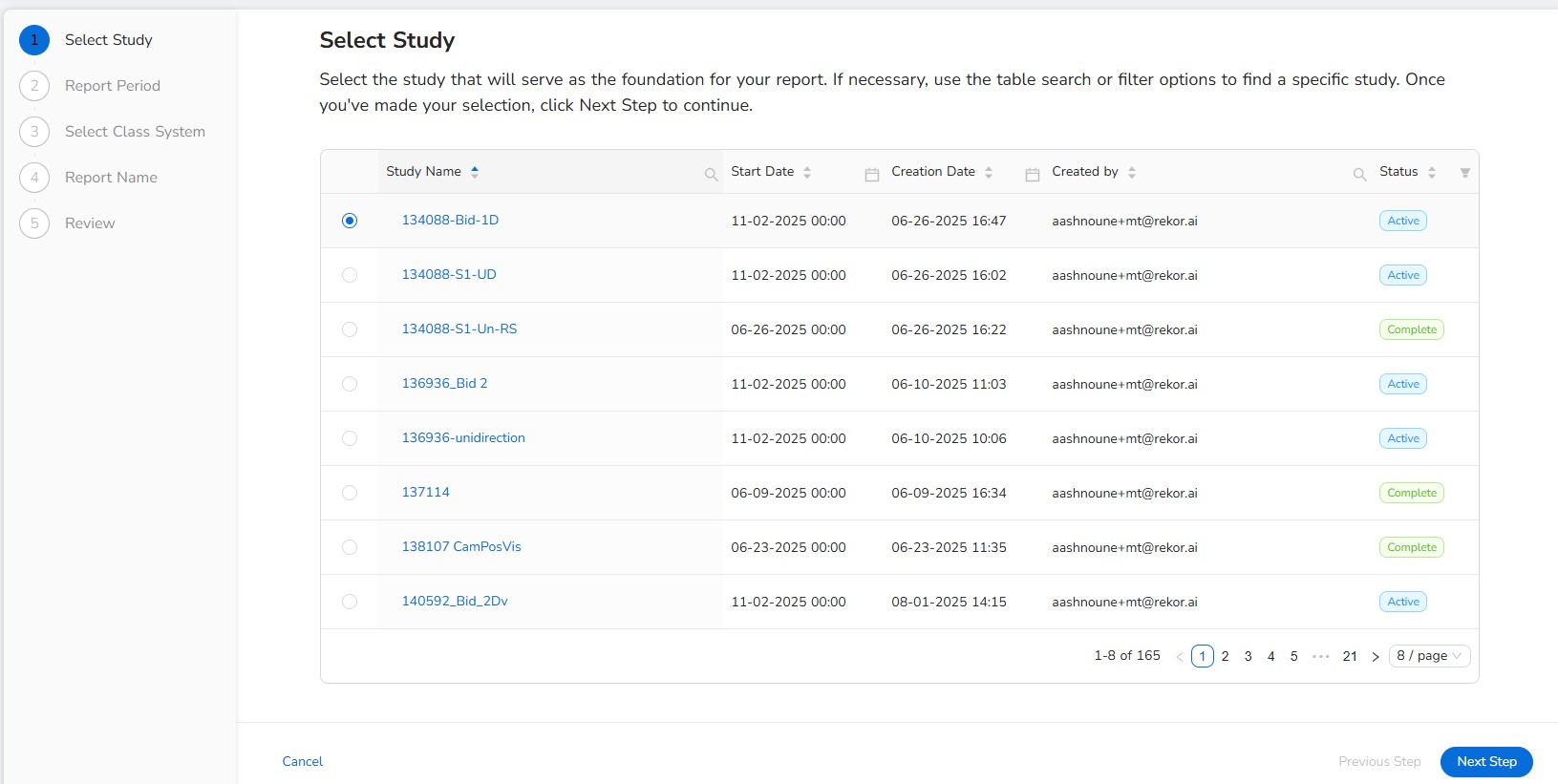
#### Select Study
Select the study that will serve as the foundation for your report. If necessary, use the table search or filter options to find a specific study. Once you've made your selection, click Next Step to continue.
#### Report Schedule
In this step, you have two options. You can either define a specific time frame for your report by selecting both the start and end dates and times, or you can choose a schedule to run your report recurrently. All reports will be created in the study's time zone.
#### Select Stations
Select the station or stations that will contribute data to your report. To select all stations at once, click the Select All button. Alternatively, you can opt to customize your station selections using the Table view.
#### Select Vehicle Classification System
In this step, choose the the vehicle classification system that matches your preferred way of grouping vehicle classes. Your choice will shape how vehicles are categorized in your report. Click table rows to expand and view detailed breakdowns of each vehicle class grouping.
#### Report Name
In this step, take a moment to choose a name that captures the objectives and purpose of your report.
#### Review
Before finalizing your report, double-check your report details for accuracy. If you spot any discrepancies, use the Previous Step button to make necessary corrections. Once you're confident that all information is accurate, click Finish.
You're now ready to generate CCS reports!
---
# Agent Instructions
This documentation is published with GitBook. GitBook is the documentation platform designed so that both humans and AI agents can read, navigate, and reason over technical content effectively. Learn more at gitbook.com.
## Querying This Documentation
If you need additional information that is not directly available in this page, you can query the documentation by asking a question.
Perform an HTTP GET request on the following URL with the `ask` and `goal` query parameters:
```
GET https://docs.rekor.ai/rekor-discover-r/class-count-and-speed/images-and-media.md?ask=&goal=
```
`ask` is the immediate question: it should be specific, self-contained, and written in natural language.
`goal` is what the user is ultimately trying to achieve, the reason they need the answer. Sharing it helps GitBook give you a better, more relevant answer. A goal is most helpful when it describes the outcome the user wants rather than restating the question. For example, with `ask=how do I create an API token`, a goal like `automate deployments from our CI pipeline` lets GitBook tailor the answer to that use case.
The response will contain a direct answer to the question and relevant excerpts and sources from the documentation.
Use this mechanism when the answer is not explicitly present in the current page, you need clarification or additional context, or you want to retrieve related documentation sections.